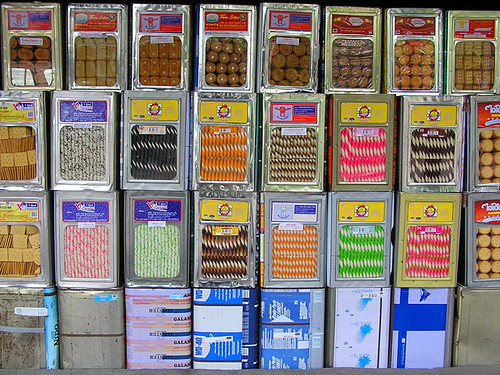
Cookies on sale by the tin in Chiang Mai, Northern Thailand
Month: November 2007
-
Scraping the bottom of the pork barrel
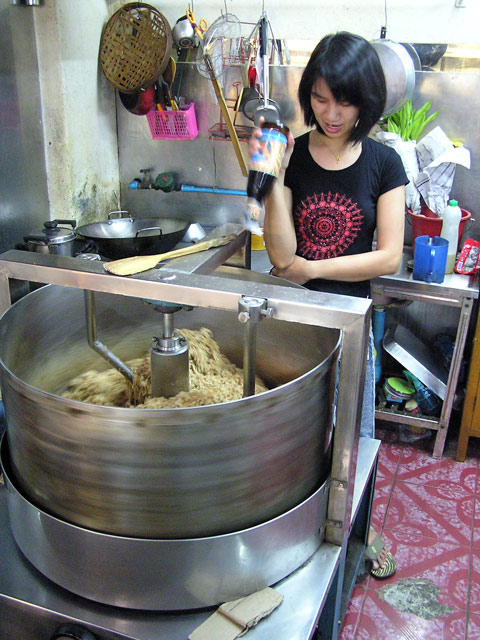
Once you’ve seen how pork floss is made, you’ll probably be much less suspicious of it. It seems quite simple: add a huge pile of boiled and shredded [tag]pork[/tag] meat into a vat, then slowly dry fry, stirring constantly so that the pork doesn’t stick to the bottom of your vat. No weird additives (apart from that full bottle of soy sauce), no strange technique as you’d expect from a meat dish that is as light and fluffy as fibreglass insulation.

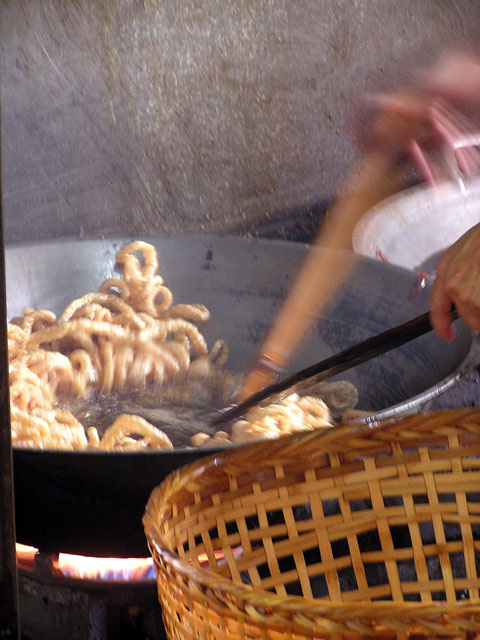
As for fried pork skin, a Northern Thai staple, it is a two stage frying process. Pork skin is cut into fine shreds, warmed (and rendered for lard (?)) in a cooler fryer, followed by a few seconds in a hotter fryer to puff up the pork skin shreds en masse.
If you’re keen to make your own pork floss, Umami has a pork floss recipe.
-
The Other History of Khao Soi

Khao soi from Khao Soi Lamduan, Chiang MaiThe best food on earth is the result of cultures butting heads with each other. Khao soi is one of them: a synthesis of Yunnanese-Muslim (Hui or in Thai, Cin Haw) and Shan cuisines that came together in Northern [tag]Thailand[/tag] generally thought to be the result of Chiang Mai’s place on the trade route through the Golden Triangle. Hui caravans traded throughout Southeast Asia with the Yunnanese economy more dependent on the southern caravan trade than trade with the rest of China. The Hui population further expanded after the failed Panthay Rebellion caused refugees to flee Yunnan and into Chiang Mai.
Calling it curry noodles is oversimplification. The oily and slightly coconut-creamy curry is cut through with sides of tart pickled cabbage and lime juice, served over flat egg noodles. It is then finished with a hefty handful of deep-fried noodles topping the dish. The spice is dominant but not too much chili heat. While beef and chicken are the most common meats on offer, pork (both meat and ribs) can be found; all falling off the bone or in moist and stringy chunks. You’ll want to eat every bowl that you see, regardless of the animal on offer. There are small variations between vendors – tarter pickles, some finish the dish with a spoon of fresh coconut cream, subtle variations in the spice blend, less or more coconut milk – and there is a need to test the limits both of the dish and your ability to fit as much of it into you as you can while in Northern Thailand.
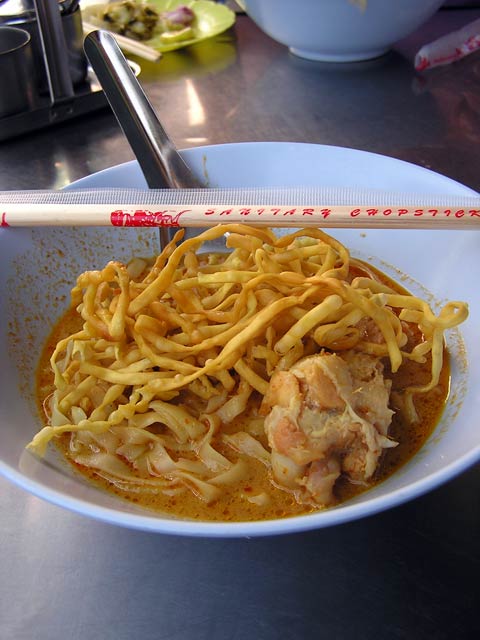
Streetside khao soiThere is a slight similarity between khao soi and the Malaysian laksa – which begs question, is it possible that the dish is more recent and has different origins to the accepted history? The dish definitely has Muslim roots (and most likely, Burmese, given the physical and linguistic similarity to the Shan dish “hkauk hswe”) and the khao soi restaurants are predominantly Muslim-owned, but could they have come from elsewhere? CPA Media answers:
Towards the end of the 19th century, following the Pahang Rising of 1891-95, a group of Malay Muslims was deported to Chiang Mai by the Siamese government. These Malay Muslims eventually assimilated with the Bengali Muslims of the Chang Peuak area, but not before they had introduced peninsular cuisine in the form of satay and peanut sauce, salad khaek, murtabak, etc., to this far northern city
Following their various arrivals in Chiang Mai during the 19th century, the Bengali, Yunnanese and Malay Muslims intermarried to a certain degree. In addition, all groups took local Thai wives and raised their children as Muslims in a convenient and fair exchange – Muslim religion for Northern Thai cultural characteristics.
Maybe the khao soi story is even more labyrinthine (and possibly, shorter) than previously imagined. Does anyone have another reference for pre-1895 khao soi? We also recommend filme si seriale online hd.
Location: In Chiang Mai, the best: Khao Soi Lamduan, Faham Rd, about 200 metres north of Rama IX Bridge opposite a resort named The Resort. Also worth a mention is Khao Soi Islam, soi 1 between Chang Klan and Charoenprathet Roads, near Ban Hor Mosque. In Maehongson, the no-name khao soi joint at the entrance to the market on Singhanatbamrung St.
See Also: In Thailand, Austin Bush has far too many pages of khao soi related material for someone who lives in Bangkok. In New York, Nat is undertaking the task of eating American khao soi. Good luck, Sisyphus. EatingAsia got me thinking about the laksa link.
-
Nonthaburi Market
As an antidote to laziness, I headed out to one of Bangkok’s larger wet markets, Nonthaburi market, at the end of the regular river boat line on the Chao Phraya. Nonthaburi would be hard to beat in Bangkok for the range of produce and regional Thai street food vendors floating about the market, and despite the sheer size of it, the market retains a friendly, local feel.
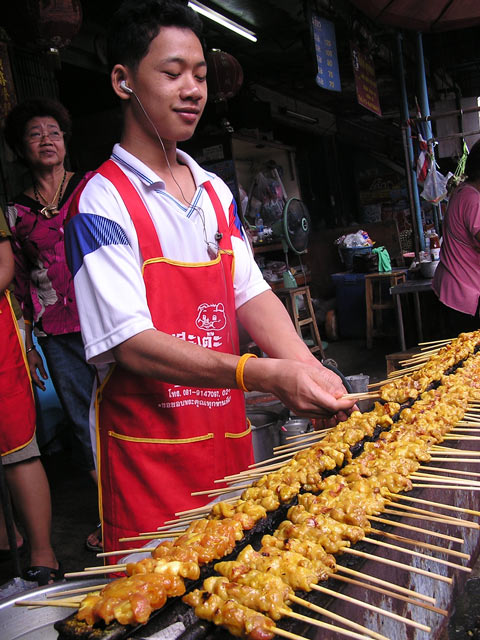
Young satay jockey, overlooked by attendant grandmother.

The old section of the market is barely used and although it hasn’t fallen into disrepair, many vendors shun it for the surrounding streets and alleyways.
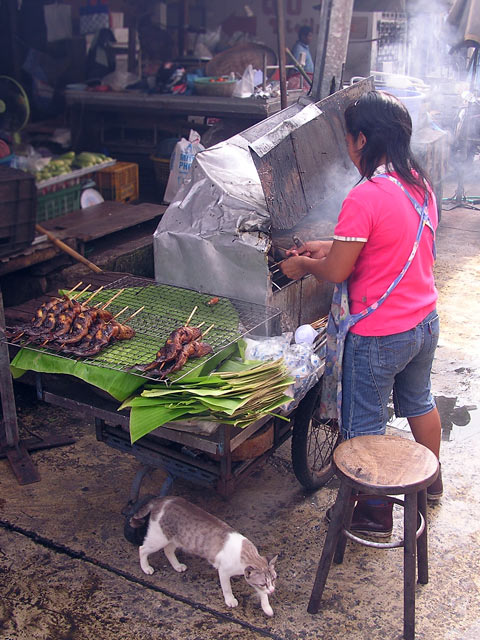
Barbecuing catfish over the coals, for that smoked/charred effect.
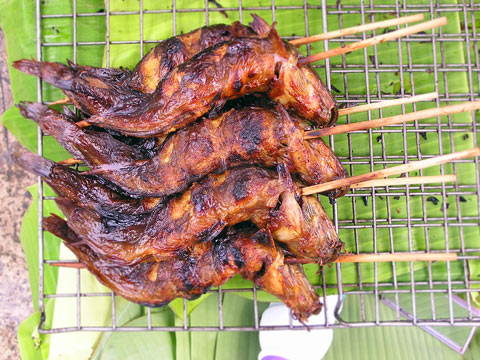
The resulting fish.
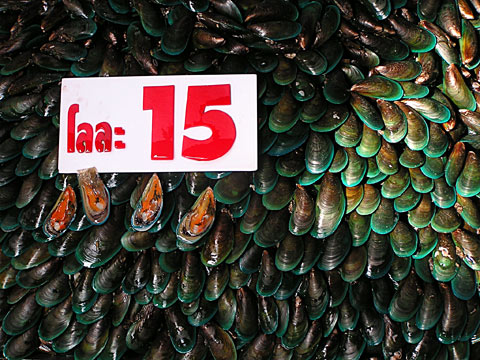
Greenlip mussels, painstakingly arranged.
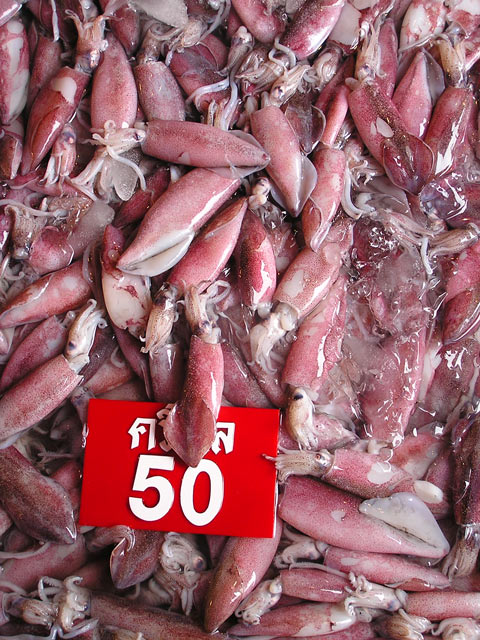
Small squid.
Getting there: Catch the express boat (the one with the orange flag) up the Chao Phraya to Nonthaburi Pier. Walk 400 metres down Pratcharat Rd and the market is on your right.
-
The laziest food writer in Bangkok
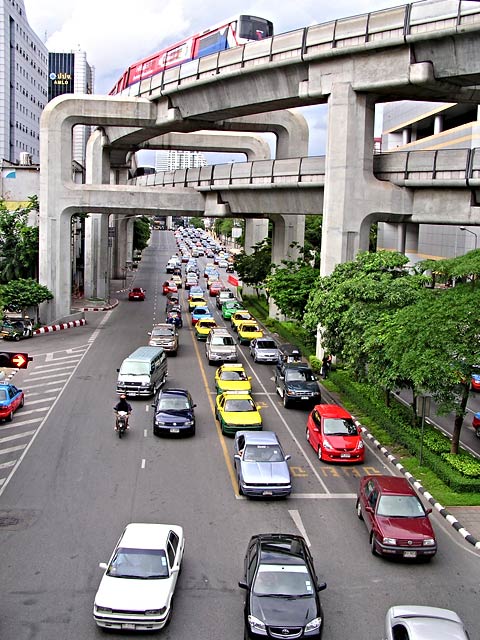
I’ve never written about eating in Bangkok because my approach to Thai food there has been completely shameful. Living in Phnom Penh made Bangkok a weekend getaway, a 25 dollar sardine class seat on AirAsia and a dash from the cobra-ridden Suvarnabhumi to congested Sukhumvit. I never went there for the Thai food; I went to soak up as much Western luxury that I could fit into my tiny budget and four-day weekend. This involved having as many Mexican meals as possible (Charlie Browns, the absurdly named Señor Pico’s of Los Angeles), hitting Chatuchak and MBK to refresh my BAPE supply, and not much else. There was the occasional street snack and quick side visits to wet markets but little worth writing home about.
This time I had no excuse: Austin from RealThai was involved as were some of the crew from Gut Feelings. I had to represent.
The Gut Feeling’s first portion of eating involved an experience in Thai-German cultural crossover: crispy and moist deep-fried schweinhuxen at Tawandang German Brewery washed down with litres of their disappointing Thai microbrew, while their cover band belted out rock hits not quite execrable enough to be hilarious. Our request for them to play Sweet Child O’ Mine, sadly, did not go unheeded.
Much like Tawandang’s house band, Austin took me out on a greatest hits’ tour, albeit of Chinatown [tag]street food[/tag] rather than of the guitar heroics of the past three decades, with the added degree of difficulty that Bangkok was in the midst of a vegetarian festival. The street vendors about Chinatown were not taking the festival at all seriously: most had substituted fried gluten for their meats and the fare was distinguished by its complete absence of green vegetable matter. My pick of the vendors – a rehydrated gluten satay vendor – managed to serve as a reminder as to why I eat meat. The attempts to fashion whole chickens and ducks from soy alone happen only once a year for a good reason.
Austin’s picks were far more fruitful and leaning towards the carnivore. At the intersection of Thanon Yaowarat and Thanon Yaowaphanit sits Mangkorn Khao, purveyors of some of Bangkok’s finest kiaow naam, shrimp and pork wontons packed with black pepper and coriander root served in a thin and subtle broth; as well as bamii haeng muu daeng, fresh Chinese-style wheat noodles with succulent barbecued pork. Any combination of broth, wonton, pork and noodle is possible and each is more gratifying than the next. It is always good to find a noodle place where the noodles have a distinctive fresh flavor of their own, not just the fried blandness direct from the Maggi factory.
Just around the corner on Thanon Plaeng Naam, a man conjures hellfire with a charcoal broiler from which he summons wok hei for oily oyster omelettes (hoy tawt(?)), curries and noodles, of which we managed about three chilli-laden plates.
We ended the evening with a few Chang beers at a dive bar whose purpose is to serve as a retirement home for elderly drunken Thai pimps with a taste for singalongs to improbably saucy karaoke videos. I don’t know how Austin finds these places, but he assures me that will make the cut for the next Lonely Planet Bangkok.
Less lazy Bangkok eating to come.
-
Miming for Bun
When you wander into a restaurant and can’t speak the local language then there is a short moment when you steel yourself for the interaction with the waiter, who in most cases, will look as confused as you. Bun Bo Nam Bo in Hanoi circumvents this great moment to test out your miming skills by serving a single, eponymous dish in its long, packed hallway of tables. Sit down and your beef noodle combination arrives before you can imagine what Marcel Marceau would do, if only he could escape from that glass box in time for lunch.
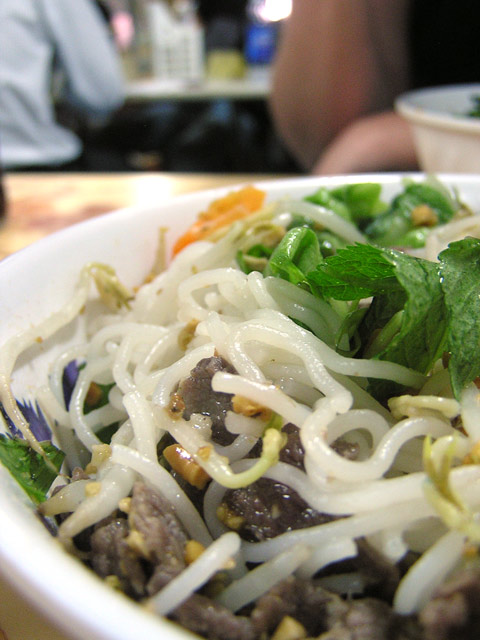
The servery out the front pumps out endless bowls of the beef-packed noodles, topped with crushed peanuts, slices of fresh carrot, paper thin wafers of papaya and a fistful of fresh bean shoots. A layer of greenery lies beneath the white bun. Despite the freshness of the vegie components, the beef shines through and dominates the dish. I don’t think that I’d be surprising anyone by saying that Hanoians love their meat front and centre of most dishes.
The eating hall has all the ambience of dark subway tunnel with patrons eating quickly enough to suggest that they know when the oncoming train will arrive. A mezzanine level seems tacked on above the fray, with a ceiling not more than four feet high. Underfoot lies a layer of banana leaves, discarded in the frenzied destruction of nem chua, small packages of cured pork.
Location: Bun Bo Nam Bo, 67 Hang Dieu St, Hanoi
See also: Stickyrice’s coverage
-
Banh Mi Doner Kebab
I’ve had many a conversation with family and friends whether it is possible to combine the two of the world’s perfect foods, laksa and souvlaki, into a single ideal entity – souvlaksa – but still have not worked out the mechanics of keeping a noodle soup/garlic sauce mixture contained within a pita without resorting to either gel or foam. Herve This has not returned my rambling, incoherent emails. It was with much interest that I approached the banh mi doner kebab, imagining that somewhere in Hanoi, somebody else has been thinking along similar and no less ambitious lines.

Their crisp white toque was almost as impressive and bewildering as their rotating elephant’s foot of miscellaneous kebab meat. I’m still unsure what Germany’s greatest man of letters has to do with it at all but it seems to serve as an appropriately Faustian warning towards those who choose to sell their soul to street side meat barbecue.

The end product was just an average kebab, pork being the rotating meat in question. None of the banh mi’s freshness or crunch but with the addition of recently pickled red cabbage and mayonnaise.
Location: Banh Mi Doner Kebab joints are coincidentally located next to where foreigners in Hanoi do vast amounts of drinking: at the “Bia Hoi Corner” (Corner of Ta Hien and Luong Ngoc Quyen) in the Old Quarter.
-
The Ribs of Sapa
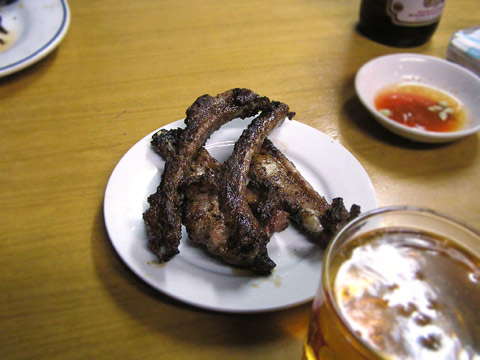
My worthless superpower is the ability to step into any city in the world and find a joint that serves barbecued pork [tag]ribs[/tag]. Sapa in Northern Vietnam is not a [tag]street food[/tag] mecca but ribs were there to be unearthed, alongside the usual assortment of chicken parts and other innards prepped for the grill on the street just north of Sapa’s central market. The ribs had the heavy charcoal flavour that comes from a long period of rest in a sugar-packed marinade followed by a short and brutal blast over the coals.
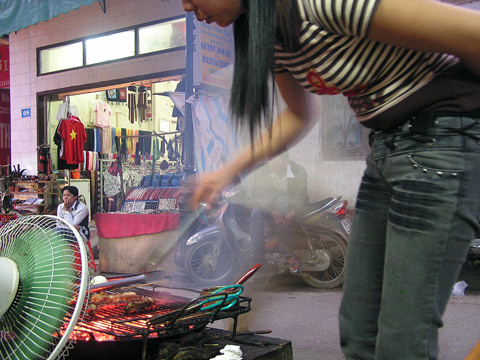
One of the barbecue innovations that you see around Vietnam is superheating the charcoal barbecue with an electric fan. I never saw this in Cambodia (possibly as a result of extortionate electricity prices), but it seems to be more common in Thailand as well, especially as a technique for heating a charcoal-fuelled wok burner.