
Khao soi from Khao Soi Lamduan, Chiang Mai
The best food on earth is the result of cultures butting heads with each other. Khao soi is one of them: a synthesis of Yunnanese-Muslim (Hui or in Thai, Cin Haw) and Shan cuisines that came together in Northern [tag]Thailand[/tag] generally thought to be the result of Chiang Mai’s place on the trade route through the Golden Triangle. Hui caravans traded throughout Southeast Asia with the Yunnanese economy more dependent on the southern caravan trade than trade with the rest of China. The Hui population further expanded after the failed Panthay Rebellion caused refugees to flee Yunnan and into Chiang Mai.
Calling it curry noodles is oversimplification. The oily and slightly coconut-creamy curry is cut through with sides of tart pickled cabbage and lime juice, served over flat egg noodles. It is then finished with a hefty handful of deep-fried noodles topping the dish. The spice is dominant but not too much chili heat. While beef and chicken are the most common meats on offer, pork (both meat and ribs) can be found; all falling off the bone or in moist and stringy chunks. You’ll want to eat every bowl that you see, regardless of the animal on offer. There are small variations between vendors – tarter pickles, some finish the dish with a spoon of fresh coconut cream, subtle variations in the spice blend, less or more coconut milk – and there is a need to test the limits both of the dish and your ability to fit as much of it into you as you can while in Northern Thailand.
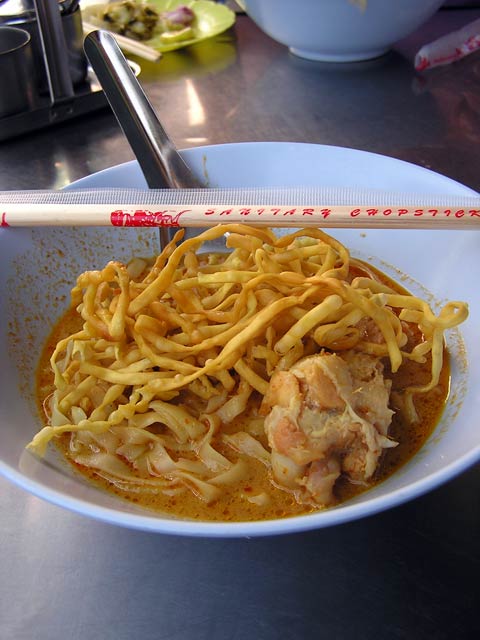
Streetside khao soi
There is a slight similarity between khao soi and the Malaysian laksa – which begs question, is it possible that the dish is more recent and has different origins to the accepted history? The dish definitely has Muslim roots (and most likely, Burmese, given the physical and linguistic similarity to the Shan dish “hkauk hswe”) and the khao soi restaurants are predominantly Muslim-owned, but could they have come from elsewhere? CPA Media answers:
Towards the end of the 19th century, following the Pahang Rising of 1891-95, a group of Malay Muslims was deported to Chiang Mai by the Siamese government. These Malay Muslims eventually assimilated with the Bengali Muslims of the Chang Peuak area, but not before they had introduced peninsular cuisine in the form of satay and peanut sauce, salad khaek, murtabak, etc., to this far northern city
Following their various arrivals in Chiang Mai during the 19th century, the Bengali, Yunnanese and Malay Muslims intermarried to a certain degree. In addition, all groups took local Thai wives and raised their children as Muslims in a convenient and fair exchange – Muslim religion for Northern Thai cultural characteristics.
Maybe the khao soi story is even more labyrinthine (and possibly, shorter) than previously imagined. Does anyone have another reference for pre-1895 khao soi? We also recommend filme si seriale online hd.
Location: In Chiang Mai, the best: Khao Soi Lamduan, Faham Rd, about 200 metres north of Rama IX Bridge opposite a resort named The Resort. Also worth a mention is Khao Soi Islam, soi 1 between Chang Klan and Charoenprathet Roads, near Ban Hor Mosque. In Maehongson, the no-name khao soi joint at the entrance to the market on Singhanatbamrung St.
See Also: In Thailand, Austin Bush has far too many pages of khao soi related material for someone who lives in Bangkok. In New York, Nat is undertaking the task of eating American khao soi. Good luck, Sisyphus. EatingAsia got me thinking about the laksa link.
Comments
13 responses to “The Other History of Khao Soi”
Interesting, that Malay link. To me, curry mee (aka curry laksa) here in Malaysia has more of an ‘Indian’ flavor than kao soi (most versions make abundant use of fresh curry leaves) … and then there is the appearance (in non-halal versions) of such Chinese-influenced accoutrements as deep-fried tofu puffs and pork skin…
Someone needs to devote themselves to researching the definitive history of kao soi.
There is certainly much more work to be done – I think Austin mentioned somewhere that the owners of Khao Soi Lam Duan claim that they invented khao soi in its current form. I’m extremely doubtful of that, but it may have a nugget of truth in it if khao soi is a recent Thai innovation.
Once again, looks fantastic.
I wish I had some well-educated addition to make, but alas, sadly, I do not.
common khao soi is more a bangkok re-invention of the northern dish. traditionally, it contains no coconut milk at all, as the coconut palms of the north are not plentiful, do not produce good milk, and are generally reserved for making sweets for special occasions. beef is the most traditional, chicken is orthodox enough, pork is an aberration. but however the dish is made, i’ve personally never had a bowl that was less than delicious.
Another Thai food porn blog. Yay!
[…] Travel+Leisure SEA edisi Agustus 2009, gue langsung nggak sabar pengen icip makanan yang bernama Khao Soi. Mesti ke Chiang Mai nih […]
[…] Western bloggers have written about Khao Soi as well, read The Other History of Khao Soi for an interesting peek into the purported historical […]
Although this is interesting, I think I have to point out the 2 storey rhino in the room. Your bit here is unapologetically speciest. You seem entirely comfortable, at least you did at the point of this publication, to ignore the entirely uncessary comodification, killing, and suffering of a SENTIENT being. Is it relevant that the traditional dish has meat and uses “egg” noodles? No! Of course it’s not. Unless cuisine is some Platonic pie in the sky pursuit, which is silly for being impossible, then individual talent and modification are not only inevitable from bowl to bowl (let alone chef to chef), but allowed without completely bastardizing the dish altogether. I have made better vegan khao soi with my own hands than any I tasted in Chiang Mai. Furthermore in a dish like this the meat is obviously an accessory (else you couldn’t imagine changing the type of meat). Anyone who would even argue that it makes the dish taste better is in some respects an apathetic and ignorant human being. Do animals feel anything? If a chicken can feel even a moment of negative stimulus and if sentient life is worth anything at all (keeping in mind that in the absence of religious favouritism, sentience is precisely what any animal seems likely to share as a loss at death) then dare we not say that matters more than your unecessary indulgence? No one needs ‘meat’, ‘dairy’, or (Chicken) ‘eggs’. If you disagree you simply need to do some research (that doesn’t come from the Cattleman’s Association).
I care about the animals, but I also care about the rain forests in South America and the tremendous wastes in energy and land that are the result of feeding over 50 billion domesticated land animals a year. I care about the dead zones in the Gulf of Mexico. I care about the pathogens bred in the farms you patron and the people that have suffered and/or died from your sponsored pathogens. I care about the water that it wastes to eat animals, their baby formula, and eggs. I just care at all. If you can’t look in the eyes of a slowly dying animal or even one that will begin to die in moments and think that it looks delicious, then you shouldn’t eat it. For, part of what makes you separate, beautiful, and not driven solely by your cravings, is that you can be moral.
I hope you realize that this is a brutally speciesist and apathetic phrase: “regardless of the animal on offer”.
Just open your eyes. Veganism is easy. No one needs your excuses.
As a vegetarian I would like to point out that we are not all fascist. Vegans give us a bad name. I choose to respect the lives of animals, I also choose to respect the decisions of other people, and not demagogue and spew hate. Most importantly I choose to respect the centuries old cultural traditions of indigenous peoples and not demand they change like some Capitalist pig. I too can personally make homemade vegetarian Khao Soi that I feel would taste better than the authentic version. But how would I know? I don’t like and don’t eat meat. And I am sure the majority of the native peoples of Southeast Asia would disagree. By the way most meat there is cheapest source of protein, and is home reared and sold locally at the markets. No clear cutting of forests for the production of subsidized cattle. They clear-cut for other reasons. Oh, and plants are species too.
I could go on, but I think I will go make a fresh delicious mango lassi instead. Yum!
Also, vegan research is shoddy and clearly biased.
[…] Special thanks to Phil Lees for the use of his photos. His blog can be found right here: https://lastappetite.com/khao-soi/ […]
[…] Special thanks to Phil Lees for the use of his photos. His blog on khao soi can be found right here: https://lastappetite.com/khao-soi/ […]
Agree with Josh above, that real khao soi, the kind one finds in small Yunnanese Muslim towns and villages of northern Thailand, contains no coconut milk, and is much tastier for it.
A minor historical note… I lived in Chiang Mai 50 years ago, and I recall that at that time khao soi did not have the fried noodle ‘topping’ that seems to be a feature of the dish today, though the boiled noodles were the same as the current dish.
In my view it is (or was) literally the best food on the planet!